Meet Betty Duker, PCM’s Art Curator
She had a lot of art, PCM had a lot of walls. Thus began the magical collaboration that surrounds us with chickens and birds and parking lots and fried eggs!
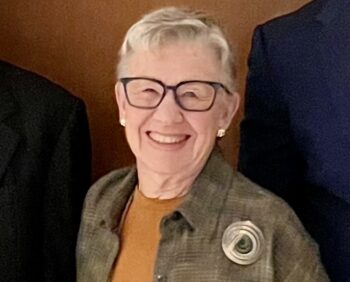
Betty Duker owns the majority of the works you walk past on your way to lessons and classes. A Pasadena neighbor, she is originally from a small town in south central Illinois, where she wasn’t exposed to much art. But Betty had always dreamt of going to Europe and managed to get there the summer after her freshman year of college. She found art everywhere—on street corners, in museums, in parks, all over public buildings, everywhere. “I sort of got it,” she says. “Being surrounded by art gave me context for other things I was learning. It brought learning to life for me.”
So when she returned from Europe, she took art history courses and began to wonder if somebody was making art in her time that would be interesting to people like her in 200 years. And she wondered if she could recognize that art. “So that’s where I began, looking for art that I thought somehow picked up on the times I was living in,” explains Betty.
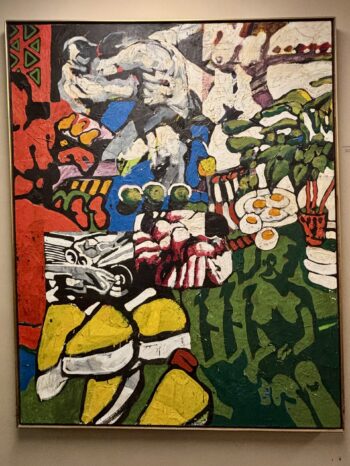
Untitled (Stag), by Peter Holbrook
Untitled (Stag), by Peter Holbrook, circa 1965 was the first painting she bought with the first money she made. (Look for it on the second floor of the main building.) Sometimes referred to as the fried egg painting (you’ll see why!), Betty saw influences from Matisse, a little bit of Andy Warhol, some Claus Oldenberg, and references to the George Bellows painting “Stag at Sharkey’s” (see the abstract boxers in the upper left). “This painting felt to me like a collage of everything that was happening in the US.”
In the following years, Betty bought a few prints which were coming into their own in the mid-60s, and a piece of two from artists she knew. But Betty says, “I don’t really like knowing the artist. Too often, I like the person, but am not wild about the art, or vice versa. So I prefer the neutral territory of the gallery.”
When Betty and her husband moved to Los Angeles in 1976 from Ft Wayne, Indiana, she discovered a city with a vital art scene. She got to know the gallerists and found those environments fed her need for adult conversation while she was raising small children. “I got the art magazines, went to museums, was looking at things all the time. The art kept me in a world of ideas.”
In the 90s, Betty curated a show from her collection—Between Reality and Abstraction: California Art at the End of the Century, which toured the country. After the paintings returned to Los Angeles, Betty realized she just had too much art to display in her home. Coincidentally, PCM had just moved into this campus, so she proposed lending much of her collection to us—what a win/win!
Yes, this solved a logistical problem, but Betty said, “I have always been hopeful that, in the music instruction here, the art would help people hear or understand in a slightly different way.” After all, many composers have been quite talented painters—Gershwin, Mendelssohn, Schoenberg. And many famous painters were skilled musicians: Braque was also a violinist and flutist; Kandinsky was a cellist and pianist; Eugène Delacroix, Henri Matisse, and Paul Klee were all violinists.
PCM’s students indeed have benefitted from being surrounded by intriguing art. A couple examples: Each year, Aimée Kreston, String Department Chair, asks chamber music students to pick a piece of art that resonates for them with the music they’re studying and write about those themes. Rachael Denny, Young Musicians Department Chair, stands before Tiajuana artist Daniel Ruanova’s Paisaje sin areas verdes, 2001, (Landscape without green areas), and asks young students what they see–crosses, boxes, scratches. “I see buildings,” says Rachael. Buildings? “Pretend you’re a bird.” (Check it out at the far end of the main hall—you’ll see what she means.)
Visual arts and music both convey emotion, inspire us, actually change our brain chemistry. What a gift that Betty saw such potential in our formerly-blank walls, now filled with interesting, inspiring art!
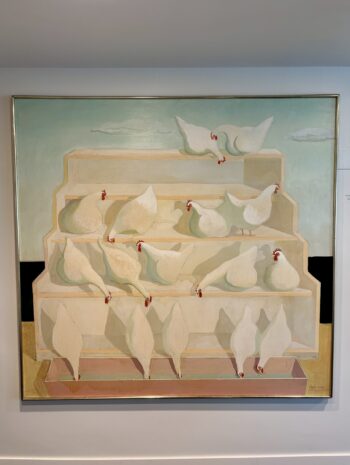
Chickens Roosting by Phyllis Manley
Some other favorites to visit:
Near the main entrance – Phyllis Manley, Chickens Roosting, 1974. “They’re such chickeny chickens! They jostle each other, all trying to get at the food, but there’s not a feather in sight. It’s a fun combination of realism and abstraction,” Betty says. (The next-door cows are by the same artist.)
Outside the office – If you know the Sierra Nevada range, two paintings by David Bungay may feel familiar. Kaweah I and Kaweah II, 1980. This river drains the southern Sierra Nevada range and flows into the San Juaquin Valley. Mountains, fallen trees, water have been turned into geometry. Betty likes to ask, “Tell me how the air smells?”
Walk from the second floor hallway of the main building to the upstairs corridor of the Learning Center – Betty and her fine installation team created a small gallery with a little bit of everything in it.
• The paper collage, Pecos River, 1981, by Richard Lutzke, is a favorite of Betty’s.
• We were sure it was an apple that Eve ate, but here she is under a grape tree! (A grape tree?!) Judith Gutierrez, Eva, 1995.
• If you’ve read about Dorian Gray, check out Jim Dine’s, Dorian Grey with Rainbow Scarf (Gallery Mikro 47A), 1968. The printer’s inking strip along the edge show the “perfect” pure colors, but they’ve paled on the deteriorating portrait.