Introduction to Digital Audio Workstation
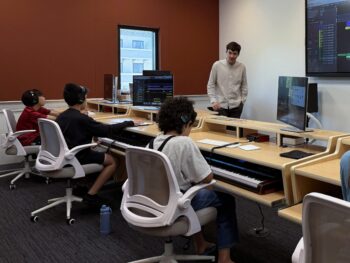
Over the summer, we officially launched our newest program – Music Technology – and rolled out the first class offering, Introduction to Digital Audio Workstation, led by Dr. Alexander Zhu.
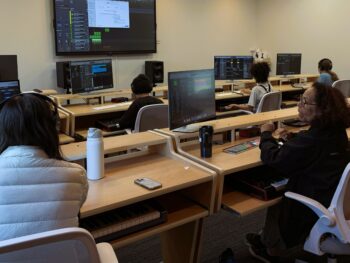
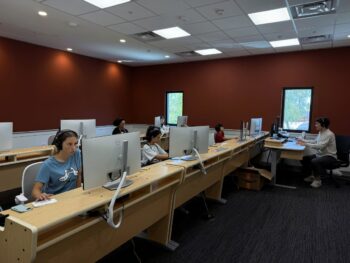
Youth and adults joined the course, some with no prior experience and others looking to improve existing skills. In the one-week crash course, students explored the basics of music production using Logic Pro. They learned to record, edit, and mix tracks, transforming them into a finished project. The classroom was filled with curiosity, creativity, and collaboration, proving that anyone, regardless of experience, can learn music production.
The class is an ongoing offering as part of the Music Technology program and can be taken during the regular school year. See below for an interview with Alexander Zhu that further discusses the program.
This interview was conducted on June 26, 2025.
What inspired you to start teaching a class focused on digital audio workstations?
Using music technology, particularly learning how to use a digital audio workstation (DAW)*, is a really critical skill, not just for training students to be well-rounded and capable musicians in the 21st century, but also because using music software and music technology is incredibly important for students to learn how to express their creativity and musicality.
What are the advantages of joining this class?
The DAW is one of the foundations of contemporary music creation. It’s difficult to find a piece of recorded music that hasn’t used a DAW. Knowing how to use it will open a huge number of doors and create lots of avenues for students to express themselves in the way they want to.
What can students expect to experience when taking this class?
The Intro to DAW course is a project-based class. Students who are new to using the DAW will, at the end of it, have a well-produced, exciting track in a style of their choice. Students who have been using one for a while will be able to workshop and get advice on their session, composition, and production values. The classes will be fun and fast-paced. There will be listening exercises and peer learning, where students can share ideas and listen to each other’s work.
Do you have any advice for students interested in production who want to join this class?
A great place to start is having some music theory background and foundational knowledge about the language of music. It’s super helpful to know how to play an instrument and read music, and it’s beyond helpful to have some keyboard skills, so if you’ve taken some piano lessons, that is a really fast way to jump into music production, because using the keyboard is a helpful tool in creating music. Also, having some creative expression that you want to achieve, such as if there’s a certain kind of song you’ve always wanted to make, or you are looking into getting into film scoring or media scoring, or if you’re interested in electronic music. Having something that you’re excited to try out is always a good place to start.
*Digital Audio Workstation (DAW): A software that allows you to record, edit, and produce audio. For example, Logic Pro and Ableton.
Are you or anyone you know interested in learning more about PCM’s Music Production program, taking lessons with our esteemed faculty members, or joining a youth or adult combo? Please don’t hesitate to reach out, and we hope to see you on campus soon!