Music and Child Development through the Young Musicians Program
Music has a significant impact on child development, building cognitive skills, confidence, and much more. Through its joyous and playful nature, music presents a great opportunity for children to learn, and research has shown that exposure to musical experiences in early childhood is greatly beneficial for children.
At Pasadena Conservatory of Music (PCM), our Young Musicians (YM) classes are built with developmental ages in mind to support your child’s growth every step of the way. Whether they are wiggling their body or humming to a tune, music can help children grow and develop.
Why Actively Making Music Matters
Music supports the key developmental areas for children: Social, Cognitive, and Motor Skills.
1. Social Skills
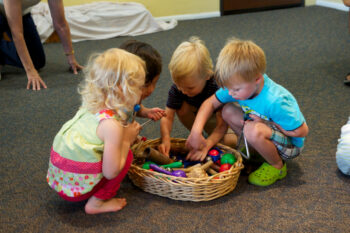
In a supportive musical environment, children can learn to express themselves, collaborate with others, take turns, and follow classroom norms. Whether they are doing drum circles or simply taking turns using an instrument, music fosters their emotional awareness, cooperation, and thoughtful communication.
2. Cognitive Skills
Early exposure to music helps develop memory, attention, language, literacy, and communication skills by teaching pattern recognition. Young Musicians Department Chair, Rachael Denny, says, “If you can grasp on to the patterns and the visual systems, it makes learning language that much easier because your brain already has those neurons connected.”
3. Motor Skills
Actively participating in making music can develop gross and fine motor skills. As children clap along to chants, bounce to the beat, and tap small instruments, they develop body awareness, coordination, and control.
Building Foundational Lifelong Skills Through Music
While music is helpful to build skills during early childhood, these skills continue to be useful throughout life.
1. Focus
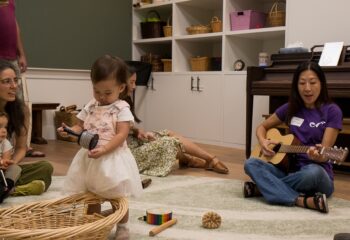
Music classes nurture a child’s ability to focus and stay engaged through careful listening, paying attention to the activities, and staying on task. These are all important skills that strengthen attention and are essential throughout life.
2. Perseverance
Repetition and practice play a big role in music, while nurturing perseverance, patience, and resilience. The ability to move forward, even when facing roadblocks or setbacks, will be beneficial throughout a child’s entire life.
3. Discipline
Weekly music classes give children a sense of structure and routine, building habits that help them stay disciplined and further develop a sense of responsibility.
4. Creativity
Being exposed to an environment where active music making is at the forefront allows children to explore and develop their own taste, sparking creativity and encouraging them to express themselves in their own original ways.
5. Confidence
By learning something new, whether singing in front of strangers or playing a new instrument with peers in a supportive environment, children gain a sense of achievement that boosts their confidence.
How PCM’s Young Musicians Classes Support Child Development
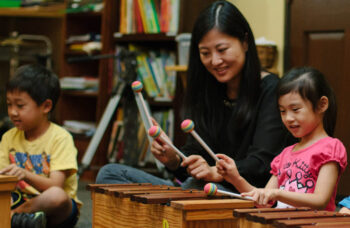
The Young Musicians (YM) classes were designed with child development in mind. With age-appropriate groups, children and caregivers participate in class activities and can incorporate what they learn into life outside of class. The YM classes are an “eclectic program,” as described by Rachael Denny, our Young Musicians Department Chair. “Primarily, we’re Orff-based because what you see is this creative movement process, but we use many different approaches to inform our teaching,” such as Kodály, Suzuki, and Edwin Gordon’s Music Learning Theory. However, keeping music fun and engaging is still the core of the program.
See below for an interview with our YM faculty, Rachael Denny, Mary Alonso, and Sharon Weed.
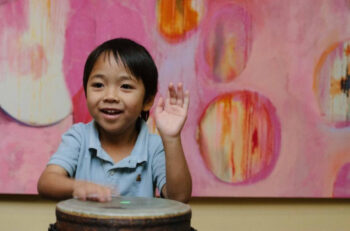
How does the YM program support key areas of child development?
Rachael Denny: The first one, of course, is socially. Preschool-aged children’s mode of play is still parallel, but they are vicarious learners, meaning that they learn by observing others. The class serves as a social environment that helps children learn how to interact with adults and other children, how to be in a classroom setting, which is essential for becoming confident students later on. The class also allows them to actively make music, instead of being passive. They use their whole bodies to learn, which is another developmental stage. There are many things which you can naturally do with a child at home, such as learning through your whole body, eyes, ears, brain, hands, feet, wiggles, tickles, and bounces, but we amplify in class.
Mary Alonso: The YM program is very sequential, so it supports key developmental areas in each age group, such as auditory, fine, and gross motor, mental, and verbal skills.
Sharon Weed: First of all, the main things you see are the babies socializing with each other and the adults. They’re learning to be good little citizens. Also, language-wise, they start babbling, and although they’re not talking with words yet, you can see they’re anticipating what comes next by using vocalizations and songs that they sing over and over again. And of course, they develop a steady beat and rhythm as their parents bounce and dance with them.
Would you say that you have seen a difference between kids who started earlier?
Rachael: 100%. With the kids that have started younger, their feeling of rhythm and beat is intensely more present than students who started later in the program, which isn’t to say that students who start later don’t catch up. However, where I see the biggest difference is in the expressiveness and joyfulness. Students who begin at a younger age play and sing more expressively, freely, and joyfully. They love making music. Music belongs to them, and that makes a big difference in how they play and perform.
Mary: There are so many fundamentals that we work on that make a big difference when kids start music lessons.
What roles do caregivers play in the learning process, and how does that influence the child’s development?
Rachael: Caregivers are essential. Having them there is really important because the energy they put into the class is the energy the child gives back. When we have active and engaged caregivers in the classroom, the kids get more out of it because the energy is good.
Mary: We’re educating them. I’m really teaching the grown-ups, and they’re turning around and teaching their little ones. They’re reinforcing and modeling. So, the grown-ups are the most important ones, because to greatly influence the child’s development, it takes daily reinforcement outside of the classroom.
Sharon: They are the main examples. They set the example and nurture it at home. The more they do it, the more the babies learn. For example, if the parents show enthusiasm in class, the kids will show more enthusiasm. But if the parents aren’t showing that much enthusiasm, the kids will follow that. So, yes, the parents play a crucial role in the class.
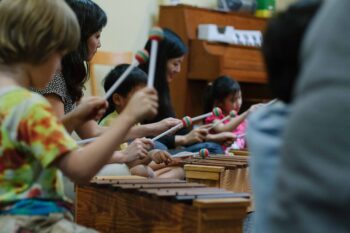
Any advice for families who want to join the program?
Rachael: Many parents think they need to start their children on instruments right away, but sometimes they aren’t ready, and it turns them off to music. I like to say that, while it can be too early to start an instrument, it is never too late. So, consider starting with a Young Musicians class. There’s no barrier of technique or instrument size, and the class gives children a chance to make music naturally and authentically. Come and check it out– try it!
Mary: Have fun, be consistent, and don’t feel pressured.
Sharon: Have fun, let loose, and keep it joyful. Take everything from class into your home and everyday activities, and keep making music daily.
Anything else you’d like to add?
Rachael: Due to COVID, I observe children who are missing social skills, coping strategies, and learning strategies that they would have otherwise developed in a class. I think music class is an effective tool to start putting those skills back into children’s lives. Even if they’re delayed, music class is a fun and engaging way to teach so many lessons, like cooperation, creativity, and connection to the world around us. So, I would say one of the best things you can do for your kid is give them a chance to join a class like ours.
Sharon: It’s never too young to start developing your child’s musicality.
Music is a joyful and effective way to supplement a child’s growth in all developmental areas. PCM’s Young Musicians program provides families with a supportive space to make music, therefore building the child’s confidence and developing lifelong skills. No matter where your child is in their development, it’s never too late or too early to start their musical journey.
Are you or anyone you know interested in learning more about PCM’s Young Musicians Program, taking lessons with our esteemed faculty members, or joining a youth or adult combo? Please don’t hesitate to reach out, and we hope to see you on campus soon!
Sources
https://headstart.gov/curriculum/article/music-child-development
https://www.carnegiehall.org/Explore/Articles/2020/12/09/Why-Making-Music-Matters
https://www.aep-arts.org/wp-content/uploads/Music-Matters-1.pdf