Bryan Fasola
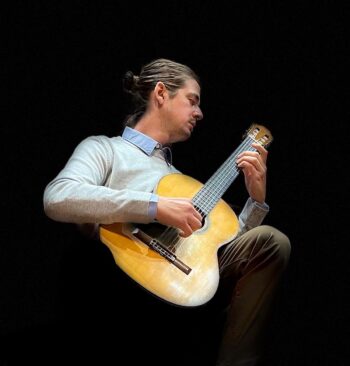
Dr. Bryan Fasola is a classical guitarist and teacher at PCM who trained in Germany under Hubert Kaeppel, and earned his Doctorate of Musical Arts at USC. He has performed on stages and radio programs across the country, including Classical California and the program “Inside the Classical Guitar.” He leads the classical guitar duo LADuo, which has performed at festivals including the Cabrillo Festival and the Southern Guitar Festival. We sat down with him to talk about his recently released debut solo album, Unplugged, and his time here at PCM.
This interview was conducted on July 22, 2026 and has been edited for length and clarity.
Why did you want to learn guitar?
I took piano lessons as a kid, mostly at my parents’ urging. Then I got interested in string instruments and switched to cello for a while – but it was heavy and I had to carry it to school every day, so eventually I wanted to quit. I took a year off from playing anything, and during that time I was listening to a lot of Led Zeppelin. That’s what got me into guitar.
Who are some of your biggest musical inspirations?
I love all kinds of music, but two guitarists really were incredibly influential. For jazz, it was Django Reinhardt and for classical guitar it was Julian Bream. I collected so many of Julian Bream’s recordings and I listened to them obsessively – no other guitarist would do. Now, I listen to everybody, but when you’re a kid you’re very pliable and I just got hooked. So those two guitarists mean a lot to me still to this day.
What inspired you to go abroad and study in Germany?
I was finishing my bachelor’s degree and wanted to get better and become more knowledgeable about the guitar before pursuing my master’s. I also wanted to study with the teacher that my teacher had studied with. I especially loved his recordings. So I called him up, auditioned, was accepted into the program, and then ended up staying in Germany for three years. My sales pitch to my parents was: if I were studying elephants, I’d need to move to Africa; but since I was studying classical music, Germany was where I needed to be.
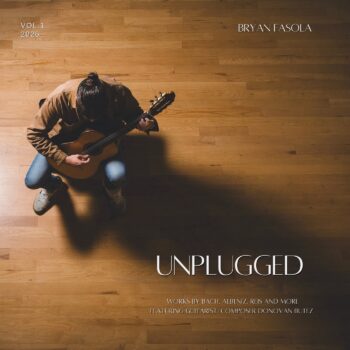
You just released your debut solo album, Unplugged. What was the process of making the album?
It really started years ago, in the sense that I had to learn and refine this repertoire long before I ever recorded it. By the time I sat down to make the album, I had about two hours of music I’d been playing at concerts and gigs — some of it, like Mallorca, for over ten years. Recording it was partly a way to reset: to let go of music I love but have played for a long time, so I’d have room to learn new pieces.
I’ve also gotten into collecting vinyl over the last five years, and wanted to make something that would sound good on vinyl. I wanted it to sound like an old Julian Bream recording, so that was my goal.
I designed it the way you’d design a record: one side has a consistent mood, and the other side shifts into something different, so you could put it on during dinner and let it run all the way through without breaking the spell. The track selection was really a mix of what I was already playing and what would work well together as a listening experience. The album isn’t out on vinyl yet, but copies are on the way.
Do you have a favorite vinyl in your collection?
It’s gonna sound really cheesy because it’s probably a lot of people’s favorite, but Kind of Blue by Miles Davis. I’ve listened to it since I was a kid and I can’t stop putting it on. That’s by far the most listened to record that I own.
Was making an album something that you always wanted to do?
As a kid I loved concept albums – Pink Floyd was a big one – so making an album has always been a dream. I also wanted it to be on vinyl because I wanted it to be physical, something you can actually hold. Right now the album exists everywhere online, but in a way it doesn’t really exist. The last way I want to listen to music is by pulling up a screen and clicking through the tracks on my phone. With a physical record, you have to make the choice to put it on and then listen to the whole thing.
How did you go about arranging some of the pieces and programming everything?
There are four movements from a piece by Bach that was originally written for keys. I arranged it for guitar almost ten years ago while I was doing my doctorate, so I’ve been playing it for a long time. And I love playing Bach, so I wanted to record it to get it down. I also arranged a Grateful Dead song that works almost like a hymn on guitar.
A lot of the album was influenced by my childhood. Mallorca was my favorite Julian Bream recording growing up. The album cover is inspired by a Robert Johnson record I loved. And the opening track is from Sweet and Low Down, a Woody Allen movie about a guitarist who’s supposedly the second-best in the world, behind Django Reinhardt — so it’s sort of a Django Reinhardt homage. All of it is an homage to all of my favorite things. In a roundabout way, each thing has its own connection to some of my favorite things growing up as a child.
The album is well-balanced with different genres for guitar. Was that intentional?
It was very intentional. I have a short attention span, and I think a lot of listeners do too. There are a lot of guitar records that I love where every piece is by the same composer. But after a few tracks that are all in the same style, I’m ready for something different – no matter how much I love that composer. I wanted this album to be a nice listening experience from start to finish, not something that requires a music background to appreciate.
How did you approach the recording sessions compared to a live performance?
My approach was actually to treat the recording sessions the same way I’d treat a live performance. On stage, you have to find a certain headspace, and I tried to bring that same mindset into the studio. For each piece, I played it three times all the way through – start to finish. Then we pieced together the best of each one. So I treated it as I would a real performance with a live audience.
Do you have a favorite song off the album and is there anything within the arrangement that stands out to you for that case?
I think Mallorca is my favorite one on the album. I think the piece just has it all. It’s a longer piece and it goes through quite a long journey in A-B-A form. That middle section is, to me, one of the most beautiful passages written for guitar. Julian Bream’s recording of Mallorca is one of my all-time favorites, so I tried to stay true to the mood he created, while still making it my own.
How do you strike a balance between taking inspiration versus making a piece your own?
For the first year or two playing that piece, I was literally copying every articulation that he did. But it doesn’t quite work because there’s minuscule differences in the way I attack the strings or I do something with dynamics. In the end, it doesn’t really work because you’re copying someone else and it’s not your own voice. So, for that particular piece, it took me a few years to find the way I wanted it to work or the way it worked for me, while still trying to keep that mood that he created in his version of it.
What is your favorite PCM memory?
One of my favorites was playing a duet with Scott Tennant at a faculty concert. He’s one of the greatest guitarists working today and we have him here on faculty, which is incredibly lucky. I feel honored to work alongside him now, because I studied with him at USC. That duet was a really surreal moment for me.
Another favorite was early on, running the advanced guitar ensemble. We played a piece called Three Songs, an arrangement by Alexander Dunn that wove together Van Morrison and the Beatles in a really inventive, classical style. It was a difficult piece to pull off, and the students did an incredible job. I remember being genuinely impressed that such young students could pull something off like that. That was one of my favorite moments here. It was really cool to see how proud they were of it.
My final question is what should people know about coming to learn at PCM?
There are a lot of programs available outside of just lessons. There are group ensembles, there are a lot of performance opportunities here and within the community. I really encourage my students to go to as many events as they can, because the faculty here are excellent musicians in their own right, and you can learn so much just from watching them play. I think you learn more from that than lessons a lot of times. Going to concerts that are put on by PCM is something I would urge everybody to take advantage of.