Johanna Borenstein
Classical flutist Johanna Borenstein is the Principal Flute at the Modesto Symphony Orchestra and she frequently plays with the LA Opera, the Hollywood Bowl Orchestra, and other area orchestras. This past summer, she also performed in the Mendocino Music Festival. As a studio musician, she has been credited in various movies: Indiana Jones and the Dial of Destiny, Elio, Hocus Pocus 2, The Mandalorian, The Greatest Showman, and others.
In the following interview, Johanna reflects on her unexpected journey to becoming a film and TV studio musician, and offers insight and advice about the industry.
This interview was conducted on July 29, 2025.
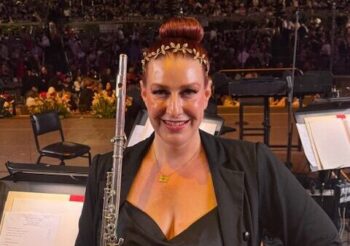
You have played for some major film and TV scores with legendary composers. What has that experience been like for you?
To be honest, it was totally unexpected when I got into the film business. I was so focused on orchestral playing and auditions, that it was a surprise when I got called to start playing in the studios. I call it the icing on the cake because so much of my career is focused on live music, so I’m tickled and excited when I get called for a studio recording. I remember my first call for John Williams. I was back home with my mom and my sister, and I remember jumping around the house and screaming. In all honesty, it was never my intention, but it’s been a wonderful experience.
How has working as a studio musician influenced your music-making?
I think it keeps me on my toes because sometimes, you don’t know what you are going to play. To quote Jim Walker, playing in the studio is “90% boredom and 10% sheer terror.” Sometimes, you get simple music. But other times, you’ll have something so difficult. Even something as simple as holding a note can be hard, so these sessions ensure that I keep my fundamentals solid.
Working in studios also helps me understand the importance of being a good colleague and a good team player. For these, you have to put your ego at the door because you can always learn something from everyone in the room. One of my favorite questions to ask my flute colleagues is, “What are your favorite tone development exercises or long tone development exercises?” So, not only do these experiences help my musicianship, but they also allow me to learn from others.
What is the biggest difference between recording in a studio and performing live?
For live performances, you can’t go back, so you must go with the flow and let go and surrender if you make a mistake; because in that moment, you are fully engrossed and aligned with the ensemble.
In a studio, most times they’ll dissect the score and do striping, where you only record certain instrumental sections at a time. By doing this, you can add in-depth layers; and because it is put under a microscope, so to speak, it is a bit less in the moment. That’s not to say that there are no ‘magical’ moments in the studio. For example, we had a recording session for Jon Batiste’s American Symphony, and this was probably one of the top five recording experiences I’ve ever had. The piece, the energy, and the personality of everyone in the room were magical — it was the funnest two-day session I have had.
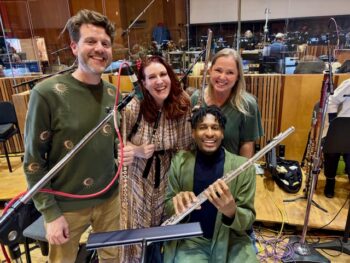
Can you share one of the more challenging experiences you have faced in your career and how you dealt with it?
For me, the challenge is the psychological experience of being in a room with big names. One time, Steven Spielberg was observing Alan Silvestri as we recorded the score for Ready Player 1. It was such an exciting experience, so I had to ground my energy and focus on playing instead of giving into the excitement and nerves.
I also remember recording the score for Dr. Seuss’ The Grinch with Danny Elfman. Because we were striping, the woodwinds didn’t play all day, and finally, at the end of the day, we had to record the whole score in only 45 minutes. It was a challenge, but you just had to do it and not get it in your head about it.
If you could go back in time and relive a recording session or performance, which one would it be and why?
This is easy. My favorite performance ever was the 25th Anniversary of The Nightmare Before Christmas on Halloween at the Hollywood Bowl with the original cast. Growing up, this has been my favorite score and movie of all time. It was very fun and a pinch-me moment for me. It was truly a magical experience to be a part of.
What’s the best piece of advice you’ve received?
One of the best bassoonists, Rose Corrigan, said to me as I was starting to work a lot that, “You have to learn how to receive compliments, even if it feels weird in your body.” That was a big one because I was playing with all the people I have admired throughout my life, and they were telling me I did a great job, but it was difficult to accept that I now fit in that space too.
And then some advice from Jim Walker, my mentor, that I always keep is, “It matters what you do with the time you have.” People can come from all sorts of backgrounds, and even if you are very talented, at some point, you have to put those hours in and work hard.
Combining these two pieces of advice has allowed me to become quietly confident. I think a lot of musicians are some of the harshest inner critics, so just know that it’s okay to accept compliments while continuing to put in the work.
Anything you would like to add?
All the things I’ve done have been amazing, but it took a long time to get there, and I stayed focused and kept working. If you look at a picture of someone’s progress, it won’t be a straight line. It could be several years at a plateau, then up. Everyone’s journey is going to have different hills and valleys — so wherever you are in that journey, just remember that there’s no straight line.