Andrew Park
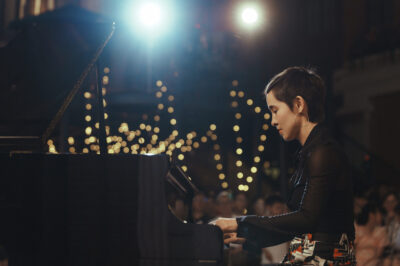
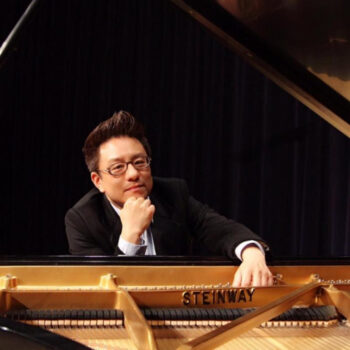
Dr. Andrew Park is a world-renowned pianist, educator, and advocate who has performed, taught, and adjudicated in prestigious venues internationally. He is an assistant professor at Azusa Pacific University and joined the PCM faculty in 2021 as an Artist-Teacher. In this interview, he reflects on his journey shaped by a musical family, supportive mentors, and international experiences; speaking candidly about his passion for music and how teaching has become a central part of his mission.
This interview was conducted on July 18, 2025.
How did you start playing the piano?
I consider myself incredibly fortunate. My father was a conductor and composer, and my mother was a piano professor at Gunsan National University in Korea. Music was more than just a hobby in our household—it was another language we spoke every day. My older brother is now a professional violinist, his wife is a cellist, and my wife is also a pianist. So for me, learning the piano wasn’t just a decision—it was part of the natural rhythm of our family life.
That said, my formal journey began when I was a young child. I was drawn to the expressive nature of the instrument and its ability to convey emotions without words. Later, I studied at Idyllwild Arts Academy under Nelms McKelvain and Antoinette Perry, and then went on to complete my bachelor’s, master’s, and doctoral degrees at the University of Southern California with the legendary John Perry. Looking back, I see how all these influences—my family, my teachers, and my early musical experiences—shaped the pianist and educator I am today.
Can you share more about your experience performing internationally?
Performing internationally has been one of the most rewarding aspects of my musical career. I’ve had the privilege of having concerts and masterclasses across the United States, in many parts of Asia, and Europe. Most recently, I was fortunate to have had several performance opportunities on the East Coast, including one at the Weill Recital Hall at Carnegie Hall in New York—an unforgettable experience. I also had the chance to perform in several beautiful European venues, including Haydn Hall in Austria, Suk Hall in Prague, Dresden in Germany, and Salzburg’s prestigious Wiener Saal at the Mozarteum, as well as multiple halls throughout Romania. Visiting and engaging with audiences in Korea, Thailand, Taiwan, and China has always been a joy—their passion and energy are truly inspiring.
How did those opportunities influence your artistic growth and perspective as a musician?
These travels have reminded me time and again that music truly is a universal language. No matter where I go, whether I’m performing solo repertoire, collaborating in chamber music with the Park Trio, or conducting—as I did with a Korean choir at Carnegie Hall—I encounter audiences that are deeply moved by the power of music. The energy you get from the audience goes both ways; it’s all about communication. You feel their energy, their vibe, and their culture. Even when you go to the same place with the same people and in the same city, you’ll feel the difference. It’s in these moments of shared emotion and cultural exchange that I grow most as an artist. Each experience not only broadens my perspective but also deepens my understanding of what it means to connect with others through music.

What motivates you to not only be a full-time artist but also a teacher?
Teaching has never been separate from performing for me—it is a calling, a mission, and one of the greatest joys of my life. While I treasure my experiences on stage, the real transformation often happens in the classroom and studio, where I have the privilege of shaping the next generation of artists. Whether at Azusa Pacific University, the Pasadena Conservatory of Music, or my private studio, I am constantly inspired by the students I work with.
Some of the most powerful moments in my teaching career have come from working with students who faced what others might consider insurmountable challenges. I once guided a student who played piano using only three fingers on his right hand and no left hand at all—he used the arm itself to reach the keys. He was later accepted into the graduate program at the University of Southern California. I also had the honor of mentoring a fully blind student who was admitted to the world-renowned New England Conservatory.
One of the most unforgettable experiences of my life has been working with Kodi Lee, a musical savant with profound autism and complete blindness. His artistry, resilience, and soul have moved me in ways that words cannot express. Today, Kodi is known around the world as the winner of America’s Got Talent, and I am humbled to have played a small role in his journey.
Inspired by students like them, I founded a free competition dedicated to musicians with disabilities. The event provides scholarships and awards, but more importantly, it brings hope, joy, and visibility to these talented individuals and their families. These experiences remind me that every student matters, every journey is unique, and every voice deserves to be heard. And through them, I continue to grow—not just as a teacher, but as a human being.
Can you tell us more about your free competition/festival for musicians with disabilities?
It has been around 20 years since I first started teaching students with disabilities. I had to study how best to teach them because I’ve never been in their position before. As I continued teaching, it has always been my dream to provide a space specifically for musicians with disabilities. With the International Association of Professional Music Teachers (IAPMT), we finally built it. The goals of this competition/festival are to provide encouragement, build courage, and offer performance opportunities. We host both in-person and online competitions with no admission fee, catering to every student. For some, this is their first time performing publicly, so not only are we hosting a competition, but it’s also a festival that uplifts the students.
If you could go back in time and relive a moment in your career, which one would it be and why?
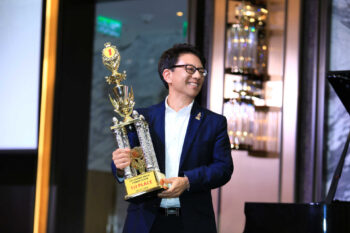
The happiest moment was when I was working hard during high school at Idyllwild Arts Academy. I practiced 5–7 hours every day and got all the support from teachers, especially my lifesaver, Ray Nelms McKelvain. He was my father figure. As a young student, he took me everywhere, from local to international competitions, which was how I won the Virginia Waring International Piano Competition, formerly known as the Joana Hodges International Piano Competition, in 1993. I won not just because I worked hard, but because I got all the support. So I’d have to say that I’d love to go back to my high school years, where I was living in the dorm, playing with my friends, and practicing hard.
What’s the best piece of advice you’ve received?
Two pieces of advice have profoundly shaped my musical life.
The first comes from my parents, who always reminded me, “Play with sincerity, not perfection.” In the world of classical music, technical mastery is expected, but what truly moves people is honesty. I carry that advice with me in every performance, every lesson I teach, and every rehearsal I conduct. I constantly ask myself, “Am I communicating something genuine through my music?” Because at its core, music is not about impressing—it’s about touching the heart.
The second piece of advice came from my beloved mentor, John Perry. He often told me, “Always approach your work with strong principles, and stay true to the fundamentals.” That simple yet powerful idea has stayed with me throughout my career. Whether interpreting a complex score or mentoring a student, returning to the basics—with clarity, discipline, and integrity—has been my compass.
These two teachings, from my parents and my teacher, continue to guide not only how I play the piano but also how I live as a musician and educator.