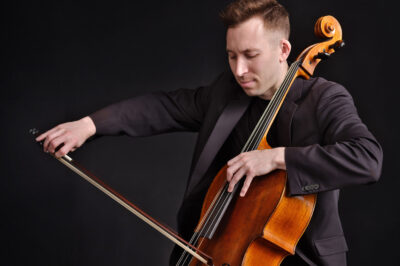
Ismael Ariel Guerrero Bombut
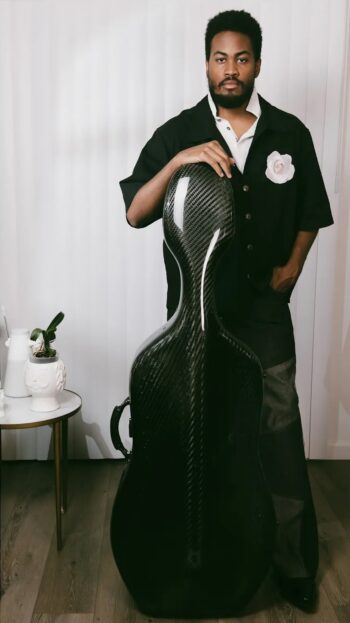
Born and raised in Havana, Cuba, where he lived until he was 17, Ismael Ariel Guerrero Bombut teaches cello at PCM. When he was seven, his parents enrolled him in a workshop for Cuba’s competitive music school entrance exams (he only chose to play cello after a teacher commented about his long arms). He then earned the last spot in one of Havana’s four music schools and committed himself to rigorous schooling, split between academics and music. After a formative early lesson in discipline — with no piano at home, he had skipped practice — a hard conversation with his teacher pushed him to commit fully to his craft. That turning point shaped the work ethic he’s carried ever since. Recently he has been part of Kelly Clarkson’s Las Vegas residency, performed with Rosalía on her West Coast Tour, and has been building his fashion line, Ismacello.
This interview was conducted on July 29, 2026 and has been edited for length and clarity.
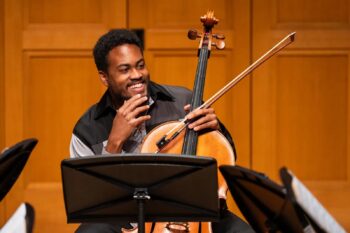
Who are some of your biggest musical inspirations?
In the cello world, my biggest inspirations are Mischa Maisky, Yo-Yo Ma, and Rostropovich. Growing up in Cuba, we didn’t have access to a lot of recordings — mostly CDs passed down. One of those was a recording of Haydn’s Cello Concerto played by Mischa Maisky and I fell in love with it. I also had a few recordings of Yo-Yo Ma playing the Bach Cello Suites. I loved his playing and everything he accomplished — I looked up to him so much growing up. And I remember a DVD of Rostropovich giving an incredible masterclass on the Bach Suites. Those three shaped me as a cellist.
I also owe so much to the Borowsky family, the Roux family, and Amit Peled, who made it possible for me to come to America. I’m eternally grateful to them. Thinking back on it, I’m reminded of all my teachers in Cuba and everything I learned from each of them. I came to the United States as a certain kind of player, but everything got refined under Amit Peled. What he taught me made so much sense as my playing developed.
I also studied briefly with Professor Kirshbaum for my master’s degree. Even in those few lessons, he taught me so much. He paid incredible attention to detail to every choice the composer made and he’d find meaning in the smallest details I might otherwise have overlooked.
Do you have a favorite concert or premiere you’ve been part of?
One of my most memorable concerts was performing the score to E.T. live with the LA Philharmonic, conducted by Gustavo Dudamel at Disney Hall. That score gives me goosebumps every time. Playing along with the film and seeing the audience was completely captivated — even though most of them had probably seen the movie a thousand times — was magical. I still think about that concert every day.
This is your second year with Kelly Clarkson! How did you get connected with her show?
It really comes down to who you know and the impressions you make — it was word of mouth. When you’re in this kind of setting, the artists are looking for people they’ll feel comfortable working with over a long period of time. For this show, they contracted the violinists first, who were then asked about other musicians they wanted to work with. That’s how the opportunity reached me.
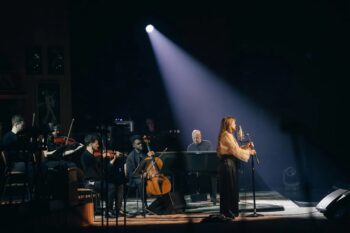
Joining her residency has been amazing. It’s unlike anything I’d done before and it’s an all-or-nothing commitment — you have to be available for every date. We play at Caesar’s Palace in Las Vegas, a venue with about 4,200 seats, and you’re incredibly close to the audience. The band itself is small: a string quartet, five guitars, two drum kits, three keyboards, four background vocalists, and Kelly. There’s about 25 of us total — all from different backgrounds, making the same music together.
A lot of tours rely on backing tracks, but not this one. Everything is played live. If we make a mistake, it’s real, and whatever we bring to the moment shapes the performance and the audience’s experience. Being that close to the crowd, you feel like a rock star. There’s a saying in this business that a good gig needs at least two of three things: good money, good people, and good music. This one has all three — what else could you ask for?
What’s the rehearsal process like?
The band comes together in stages. The core group — drums, guitars, keyboards — arrives two to three weeks before opening weekend to start working things out, and the rest of the band follows. Strings usually come in about a week before the show. By then, thanks to our arranger, Joe Trapanese, the charts are already worked out, so we just come in and blend with the group. The process is smooth. We spend that week adding smaller details and refining the set list, along with practicing our individual parts. When I’m not playing, I love just listening to every piece and every part. It’s incredibly fulfilling.
You also toured with Rosalía — how did that compare to the Kelly Clarkson residency?
A tour means more consecutive dates and a lot less rest than a residency. I got to play most of the West Coast leg of Rosalía’s US tour — Los Angeles, San Diego, and Vegas. Her Lux show was a masterpiece of its own. She sang everything live, and her voice is amazing. Her creativity and ambition are through the roof. I can’t imagine how much work goes into a production like that. We were lucky to be positioned in the center of the arena, so even though Rosalía performed out front, we had a VIP view of the whole show while we played.
Compared to Kelly Clarkson’s show, Rosalía’s had more strings — closer to a chamber orchestra — with different instrumentation and a different style of music altogether. There were also more costume changes, and the arenas held far more people, probably at least triple the size of Caesars Palace.
Both shows are incredible in their own right, and I feel lucky to have been part of them. I’ve been listening to Rosalía since Bizcochito came out around 2022, and watching her transform artistically and find her voice over the years has been amazing. Kelly Clarkson is one of those artists whose songs you know without always realizing they’re hers, until you really pay attention and realize what a huge catalogue she has. She has an incredible voice, and I’ve been fortunate to share the stage with artists like her. Watching them display their artistry live has been genuinely inspiring.
You’re also a fashion entrepreneur. How did you get into fashion and designing your own clothes?
My fashion awakening really began after I moved to the United States. In Cuba, I wore a uniform every day for school, partly because of our financial situation, so I didn’t have much chance to express myself through clothing. Once I got here and stopped wearing a uniform, I realized how much fun it was to put pieces together and express something through what I wore.
Ismacello has been my online alias for year. I thought it sounded cool even before I had internet access. Once I finally got online, I claimed it everywhere I could.
The idea to actually design came from an unexpected moment. I was trying on hats with my girlfriend, and she suggested I put “Ismacello” on one. I loved how it looked, took the hat home, and started thinking seriously about fashion. I realized I had the eye for design, even if I needed to team up with people who could help bring my ideas to life, sourcing trims and fabrics, and turning a concept into a finished piece. Now I’ve built those relationships, and I love the whole process.
Beyond just designing clothes, I wanted to think about who I was designing for. Over the years, I’ve come to love designing custom pieces for artists. Some are friends, some are people who find me on Instagram and want something custom, or fall in love with a piece I already have in stock.
My dream is that one day, an artist heading to the Met Gala reaches out and says, “I’d love to commission a piece from you.” I have some crazy delusional dreams, but I see them very clearly — and with time, patience, and hard work, they’ll all come true.
Do you have a dream person you could design for?
I’ve been fortunate to design for artists who’ve been a big inspiration to me — like Gustavo Dudamel, Kelly Clarkson, Rosalía, and Jon Batiste. It’s my way of thanking them for the opportunity to share the stage with them.
Do you have a favorite PCM memory?
One of my favorite memories goes back to one of my first Musical Interludes. I love how the concerts are curated around a theme, followed by a reception. And leading up to the concert, there’s an open dress rehearsal, which lets audience members connect with us a bit more, and us with them.
What should people know about coming to learn at PCM?
We’re here to help guide and support them the best we can. There are plenty of performance opportunities if that’s something you’re looking for, and I love how active and inclusive the community is. They really try to keep everyone involved. There’s also a wide range of ages, from more mature students to much younger ones, and that diversity is really healthy for the community. I also love the recent renovations. The new classrooms and the new amphitheater have opened up so many possibilities for concerts.
What is a future goal you have for yourself, or any upcoming projects you want to shout out?
I’m really excited about where my fashion projects are headed. I’ve been pushing myself out of my comfort zone with designing and putting a lot of creative energy into it. I’ve been working on pieces for some really cool artists, and I can’t wait for people to see them.
On the music side, I just want to keep learning about myself and my identity, and keep growing on my instrument. It’s easy to fall into a routine once you’re out of school. I’ve been getting into jazz recently, and I’d love to land a jazz gig where I can put what I’ve been working on in the practice room to use. More broadly, I want to expose the cello to as many genres and opportunities as possible. I don’t want people to think it only belongs in an orchestra or in strictly traditional settings. There are so many artists doing incredible, boundary-pushing things with this instrument, finding their own voice and making real art with it.
I’m excited for what’s ahead, to keep welcoming new opportunities to express myself, and eventually get to a place where people can really see the relationship between what I create in fashion and what I create in music.
Any final thoughts you’d like to share?
Stay committed to the journey. That’s what matters most. We focus so much on the result that we forget about the journey itself. For anyone who’s wanted something badly and then achieved it, I think what made it fulfilling was the journey, not the result. Some things in my life came very easily, and they never felt as good as the things I really worked for where I struggled, almost gave up, and then found a way to pick myself back up. That push and pull, that non-linear path, is what I keep reminding myself of when setbacks come. Things happen for a reason, so try not to get discouraged when things don’t go the way you want them to go.