Ari Kessler
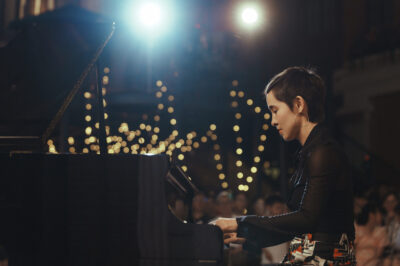
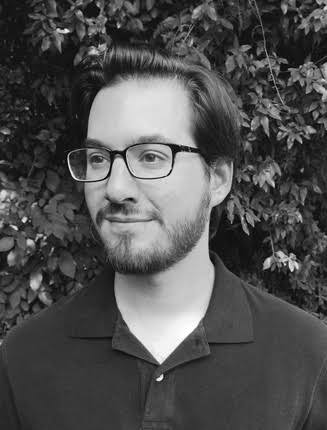
Ari Kessler is a versatile educator, pianist, musical director, composer, and arranger currently based in the greater Los Angeles area. Born and raised in Youngstown, Ohio, Ari holds a B.A. in Jazz Studies from The Ohio State University and a master’s in Music Education from Teachers College, Columbia. Ari currently teaches Young Musicians classes to 2nd–5th grade students at Longfellow Elementary, bringing an Orff Schulwerk approach rooted in improvisation, movement, and student-led composition to the classroom.
This interview was conducted on August 5, 2026 and has been edited for length and clarity.
Give me some background on yourself and how you got started in piano.
I started piano before I really had a choice. One day your mom just sits you down and says, “You’re doing piano.” So I had lessons from a young age, which I feel very fortunate about. This was in the Midwest, and my teachers were old-school, Russian-immigrant classical pianists, straight up and down classical training. I was always interested in jazz — a cousin gave me a Thelonious Monk and John Coltrane album when I was twelve — but I didn’t really pursue it until high school.
What made you want to teach music?
In my twenties, I was living in New York, and I realized at some point that I just wasn’t built for the hustle — I couldn’t live that way. So I went to grad school, not really knowing if teaching would take for me, and it really did. I get so much out of working with elementary-school-aged kids. Teaching young kids forces you to simplify, to think about things in very basic terms, and that’s been good for me as an artist. I also just really enjoy the teaching itself — there’s a whole art to lesson design.
What does social-emotional learning through music look like?
The social-emotional learning (SEL) lens on a lesson is a bit like an eye exam, where they switch out the lenses one by one. First there’s the planning lens, then the assessment lens, and then the SEL lens, where you examine a lesson for how it will affect students’ social-emotional development (e.g. self-awareness, relationship skills, responsible decision-making, etc.). I think music teachers were already doing this instinctively, long before the term was solidified academically.
How did you become connected with PCM and Longfellow?
Rachael Denny, who heads the L.A.-area Orff Schulwerk courses, is how I found my way here. I met her while doing my own Orff Schulwerk training, and when I was later looking for a job, there she was.
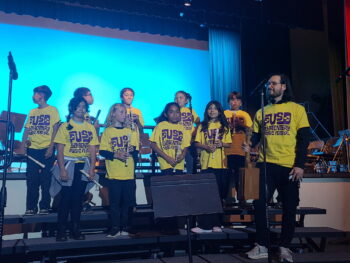
Last year was my first year with Longfellow. Every grade has state-mandated standards you need to hit in some way, but one of the reasons I love teaching music is that there’s no single set way to get there. I really enjoy the Orff Schulwerk approach, where there’s a lot of student input into how a lesson unfolds. Your job is really to build a nice picture frame for the students to color in — and there’s a lot of composition and improvisation involved along the way.
What is Orff Schulwerk?
Orff Schulwerk is a teaching philosophy that takes its name from the composer Carl Orff, known for the opera Carmina Burana, among other works. In 1920s and ’30s Germany, he worked with dancers connected to the Dalcroze school, and Gunild Keetman. At its core, it’s a movement-focused, improvisation-focused, tonic-harmony-focused, authentic expression of children’s musical culture.
Why is musical mentorship so important?
You really need that one-on-one attention as you’re growing into yourself as a musician. It’s hard to reach a certain level of skill without it. There’s so much more practice material available today than when I was a kid; you can go to YouTube and get five years’ worth of piano lessons in a pretty decent sequence. But without a teacher bouncing ideas back at you, it’s just a vacuum.
How do you balance having different skill levels within your classes?
For me, the point of the class isn’t to make you an awesome recorder player — it’s to help you find a way to love music. That might be the part where you dance around the classroom with your recorder, the part where you’re learning notation to write and compose, or just the pure practice of getting good at an instrument. Naturally, there’s going to be a bell curve in skill level, but the kid at one end of that curve has to be having just as good a time as the kids at the other end.
What’s been something unexpectedly fun or challenging about your time at Longfellow?
Unexpected things happen every day. Suddenly a kid who hasn’t said a word in three weeks knows the answer. Or we switch the mode of assessment from singing back to writing it down and a kid who hadn’t been standing out is suddenly right on it, showing an ear you wouldn’t have guessed they had. Kids constantly discover that they can improvise, and really cool stuff comes out of that. Or they realize they can pick up music by ear. It happens all the time.
What should the PCM community know about the Longfellow program?
This is only going to be my second year at Longfellow, but it’s a really good partner program for the district. Pasadena Unified does a great job with their music offerings, in my opinion, but in grade school, it’s really important to have a year-round presence for music. It’s also great that PCM gives fourth and fifth graders a choice of instrumental programs. Pasadena Unified is very strings-focused in the early grades, but the 4th and 5th graders at Longfellow can choose keyboard, recorder, choir, or percussion — all taught by PCM faculty.
What’s next on the horizon for your classes this coming year?
Every year, I try to do a bit of professional development and pick up something new. Last year, I took a course out of San Francisco on jazz and the Orff Schulwerk model with Doug Goodkin, who’s something of a pedagogy hero of mine. The workshop focused on how to draw composition out of your students, so I’m hoping to bring more student-led composition into my classes this year.